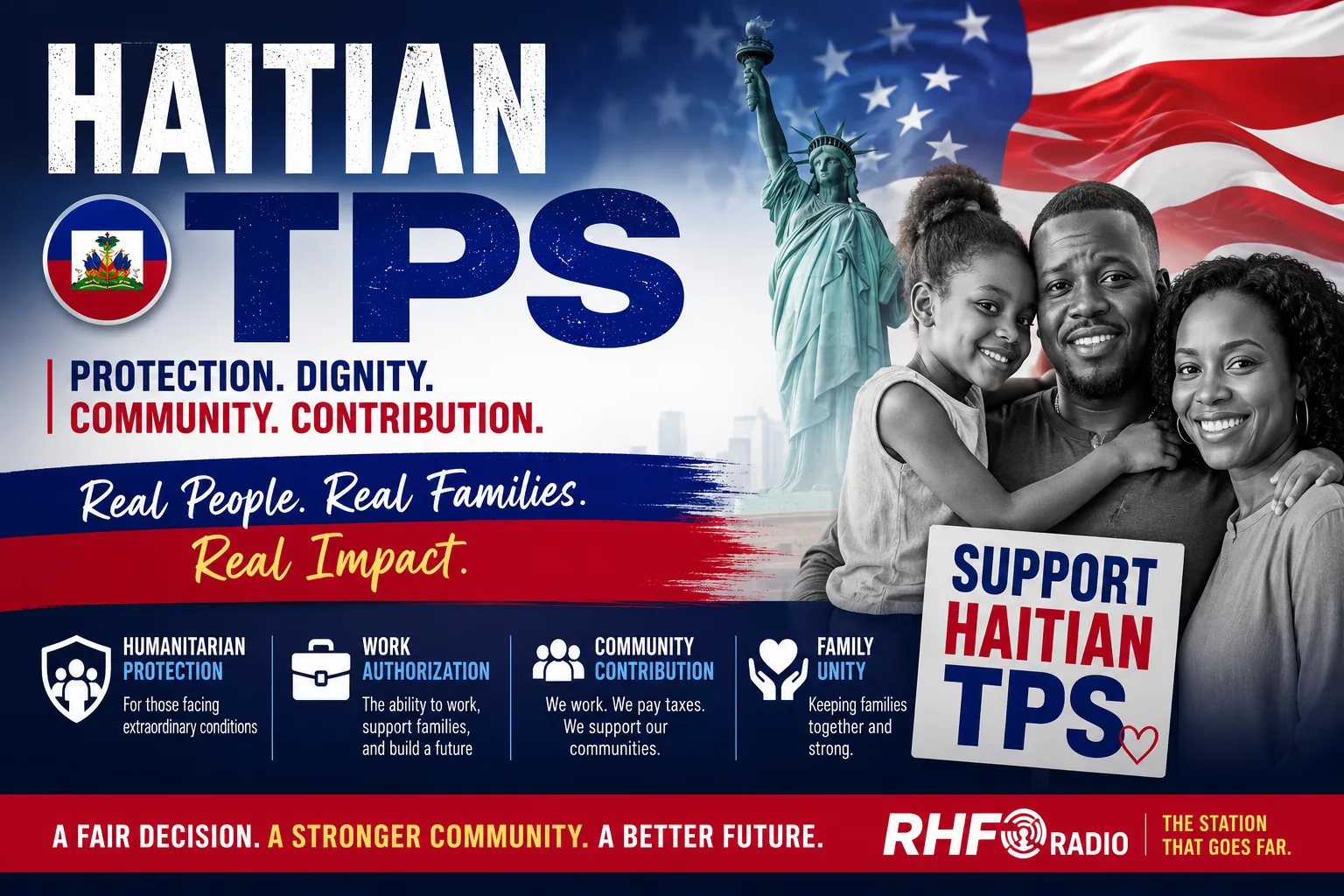
Haitian TPS: A Decision That Will Shape Thousands of Lives
Haitian TPS: A Decision That Will Shape Thousands of Lives
The debate surrounding Temporary Protected Status (TPS) for Haitians has once again become one of the most important issues facing the Haitian community in the United States. While politicians, legal experts, and advocacy groups continue to debate immigration policy, the reality is that behind every policy decision are real people, real families, and real communities.
What Is TPS?
Temporary Protected Status is a humanitarian immigration program created by the United States Congress under the Immigration Act of 1990. It allows nationals of designated countries experiencing extraordinary and temporary conditions—such as armed conflict, environmental disasters, epidemics, or severe political instability—to remain temporarily in the United States and obtain authorization to work legally.
TPS does not provide permanent residency or citizenship. It is a temporary form of humanitarian protection that must be renewed or redesignated by the U.S. government based on conditions in the beneficiary's home country.
For Haiti, TPS has become a lifeline for many families over the years, particularly after the devastating 2010 earthquake and subsequent humanitarian crises.
The Objective Reality
Supporters of ending TPS often argue that the program was never intended to become permanent. They believe immigration laws should be applied consistently and that temporary protections should remain temporary. They also argue that every administration has the responsibility to determine whether the original conditions that justified TPS still exist.
Others believe that immigration policy must balance humanitarian concerns with border security, enforcement of existing laws, and the integrity of the immigration system.
Those arguments deserve to be heard because immigration policy is ultimately a matter of law and public policy.
However, the discussion cannot end there.
The Human Reality
For thousands of Haitian TPS holders, the United States has become home.
Many have lived in America for more than a decade.
They have built businesses.
They have purchased homes.
They have raised American-born children.
They work in hospitals, schools, transportation, construction, hospitality, manufacturing, and countless other essential industries.
They pay taxes.
They contribute to Social Security.
They support local economies.
Most importantly, they have become part of the fabric of American society.
Removing TPS affects far more than immigration status. It affects families, employers, churches, schools, neighborhoods, and entire communities.
Haiti's Current Situation
Any discussion about Haitian TPS must also consider the current realities on the ground in Haiti.
The country continues to face significant security challenges.
Many regions remain affected by armed violence and instability.
Economic conditions remain extremely difficult.
Public institutions continue to struggle with limited resources.
Healthcare, education, transportation, and infrastructure face enormous challenges.
These realities have been documented by numerous humanitarian organizations and international observers.
The question many ask is straightforward:
Can Haiti safely and sustainably absorb tens of thousands of returning citizens today?
That question deserves careful consideration.
A Nation Worth Rebuilding
At RHF RADIO, we also believe another conversation deserves attention.
Haiti cannot remain dependent forever on humanitarian protections granted by foreign governments.
Every Haitian dreams of seeing a stable, prosperous, and peaceful Haiti.
Most Haitians living abroad did not leave because they wanted to abandon their homeland.
They left because opportunities disappeared.
Many continue to send money home every month.
Many invest in family businesses.
Many build homes they hope to return to someday.
Many still dream of retiring in Haiti.
Returning home should never be viewed as failure.
Returning home should become an opportunity.
That, however, requires a Haiti capable of welcoming its sons and daughters with security, employment, functioning institutions, and hope.
Shared Responsibility
Haiti's challenges did not emerge overnight.
They are the result of decades of political instability, weak governance, natural disasters, economic hardship, corruption, and complex international influences.
No single government, political party, or foreign nation bears sole responsibility.
Likewise, no single solution will solve every problem.
The Haitian people, their elected leaders, civil society, the private sector, and international partners all have roles to play in building a stronger future.
Beyond Politics
TPS should not become merely another political talking point.
It is about people.
It is about parents trying to provide for their children.
It is about employers relying on experienced workers.
It is about communities that have benefited from Haitian contributions.
It is about a nation that still hopes to welcome its diaspora back under better circumstances.
Looking Forward
Whether one supports extending TPS or ending it, there is one point on which many people can agree:
The long-term solution is not permanent temporary protection.
The long-term solution is a Haiti that is safe, economically vibrant, politically stable, and capable of offering opportunity to its own people.
That vision will require leadership, accountability, investment, and cooperation—from Haitians themselves and from the international community.
Until that day comes, discussions about Haitian TPS should remain grounded in facts, compassion, and respect for the dignity of every individual affected.
At RHF RADIO, we will continue to provide balanced information, encourage thoughtful dialogue, and amplify the voices of the Haitian community around the world.
Because every policy has consequences. Every decision affects lives. And every Haitian deserves to be part of the conversation.
RHF RADIO — The Station That Goes Far.